Grand design for a company’s moonshot
Points
- Make opportunities for creating a long-term mission and vision
- Extract a timeless raison d'être from the vision stories of all employees, and make it the company mission
- Use copywriting and vision creation so all employees can identify with the company’s mission, vision and values, and make them their own
Speaker
![Lena Okajima]() Lena OkajimaCEO of ALE
Lena OkajimaCEO of ALE
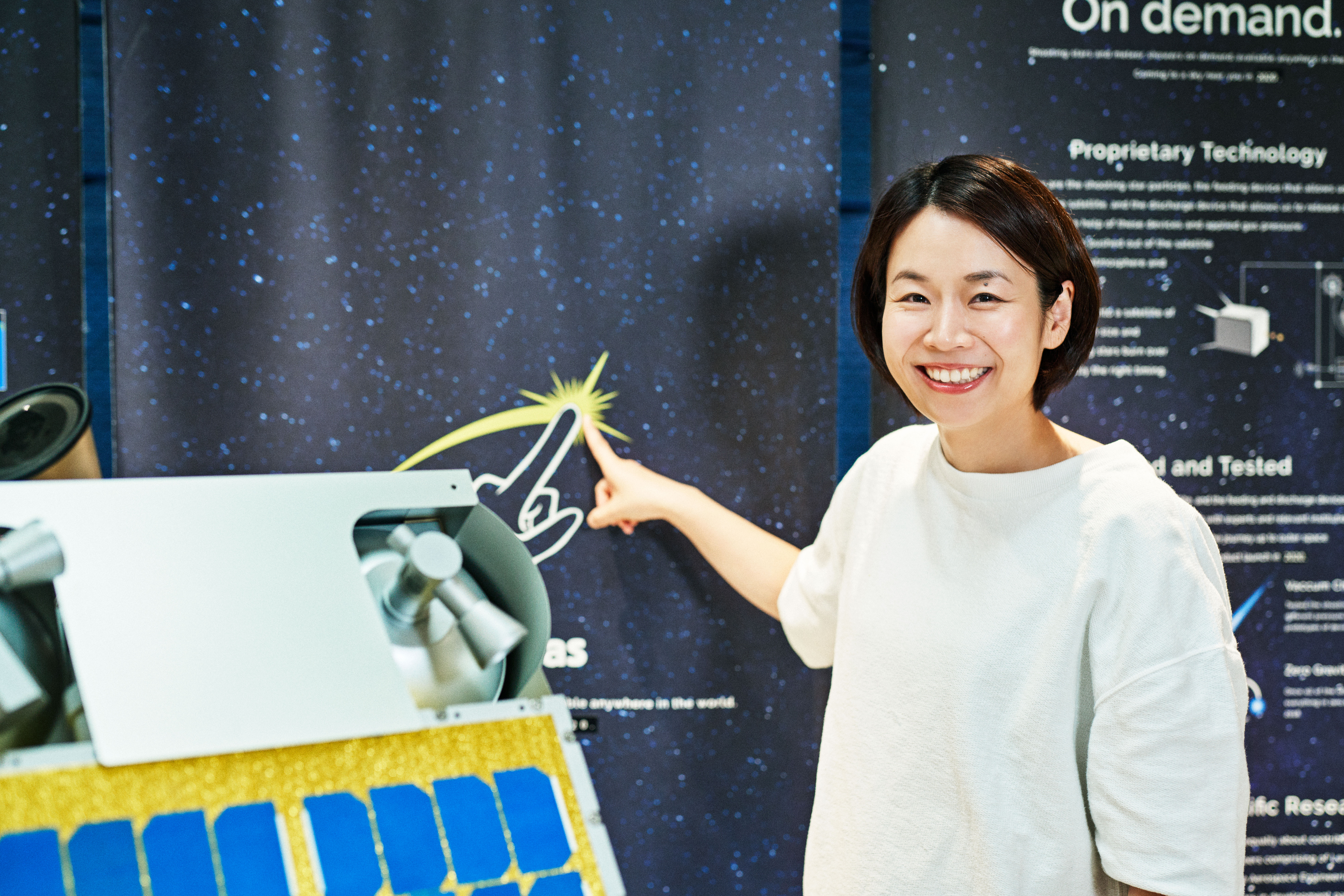
As a student, Okajima founded a science and entertainment company whose services included game development and facilitating collaboration between academia and business. She was selected as a member of the Japanese Aerospace Exploration Agency's (JAXA) Open Lab. After graduating, she worked with strategic bond investments and private equity at Goldman Sachs. In 2009 she founded a consulting firm for businesses in emerging markets. She founded ALE in September 2011, and created its Sky Canvas project for launching an artificial shooting star.
Bringing space closer to people, and connecting science with society
At ALE we are developing a satellite for launching artificial shooting stars. In addition to creating entertainment, our wish is for this grand science experiment to contribute to basic research and technology development. Basic research forms the foundation of science, and has lead to great advances for humanity in the past. However, many researchers now warn that investments in the future are dwindling. ALE was founded with the idea to create entertainment through basic research, and thus acquire value not only from the results, but also from the process.
Creating an organization that unifies employees while also giving them freedom of action
As the size of the company and the number of employees grew, we started facing new problems. It was no longer enough with individual effort to grow; we needed team collaboration. I spent much time thinking about how to grow the company structure organically, while at the same time preserving the speed and flat organization that characterizes a startup. It was in this period that I read the popular book Reinventing Organizations on self-managing organizations. One of the quoted reviews on the cover was by Kunitake Saso, and I decided to contact BIOTOPE.
Polish your identity before polishing your organization structure
Saso taught me that a vital part of organization building is to share the organization’s core ideals internally. At the time, we did not have a good expression of ALE’s core ideals. The company was getting increased exposure in the media and interest from the business world, but most of the attention was focused on the entertainment aspect of the artificial shooting star project. It was frustrating to be perceived as an entertainment company, when what we really wanted to do was contribute to science. Entertainment was merely a means, not the end goal. Therefore, we decided to first review our mission, vision and values.
Building a foundation by extracting the imagination and thoughts of the founder
As a first step, Saso proposed creating an advisory group consisting of members from both inside and outside the company, with which I could discuss my thoughts and ideals. He assembled a group of ALE employees, stockholders and astronomers. I spoke to them about what I imagine humanity can achieve in space in the next 100 years. Ever since founding the company, everyday operations had left me little time to think about the distant future, but now I had an opportunity to consider the larger picture. We had a deep discussion on what our next step after entertainment in space might be, and ended up with the keyword “curiosity”. People’s curiosity is what opens the gate to space, and to the progress of humanity.
Company-wide workshops, and creating a story that leads towards the future
Based on these discussions, Saso created a story connecting the past, present and future. This story was shared within the company, and a workshop was organized in which all company employees participated. Each employee’s thoughts on our next stage after the shooting star project were expressed on a timeline, allowing us to discuss what goals everyone shared. I best remember how a discussion about whether space travel would become commonplace by 2030, led someone to ask, “Then is it really enough for us to continue working on entertainment even after launching the shooting star?” We finally concluded that ALE’s core goal was to connect science and society, and thereby made explicit the sentiment that we were not merely trying to entertain.
Putting the company’s DNA into words with copywriting
Together with a professional copywriter, we put our mission into words and involved everyone in polishing it. It summarized exactly what we had wanted to say all along, in a short phrase: “Fuse science to society and bring space into our culture.” The “fuse science to society” part was not much different from our earlier slogan, “Promoting both science and business”; but adding “and bring space into our culture” makes it clear that we are aiming for a future beyond that. ALE’s first phase will last until 2030, during which we will be learning about space by launching a shooting star. After that, we enter our creative phase, and will focus on how to enjoy and live in space. We still do not know exactly how to realize that, but putting our mission into words clarified what direction we should move in. In this same process, we also determined our vision and values, all of which helped unify our organization. It was a reminder for me of the power of words; both as a unifying force, and as a compass for a leader.